
During the second world war with an occupied Europe, drifts of immigrates both European and returning Scots were attracted to Glasgow. Among these refugees were two artists Jankel Adler and Josef Herman who went on to exerted a strong and refreshing influence on independent art in Scotland during this period.
A dynamics force, also returning to Scotland from Paris, was the Colourist JD Fergusson and partner Margaret Morris.
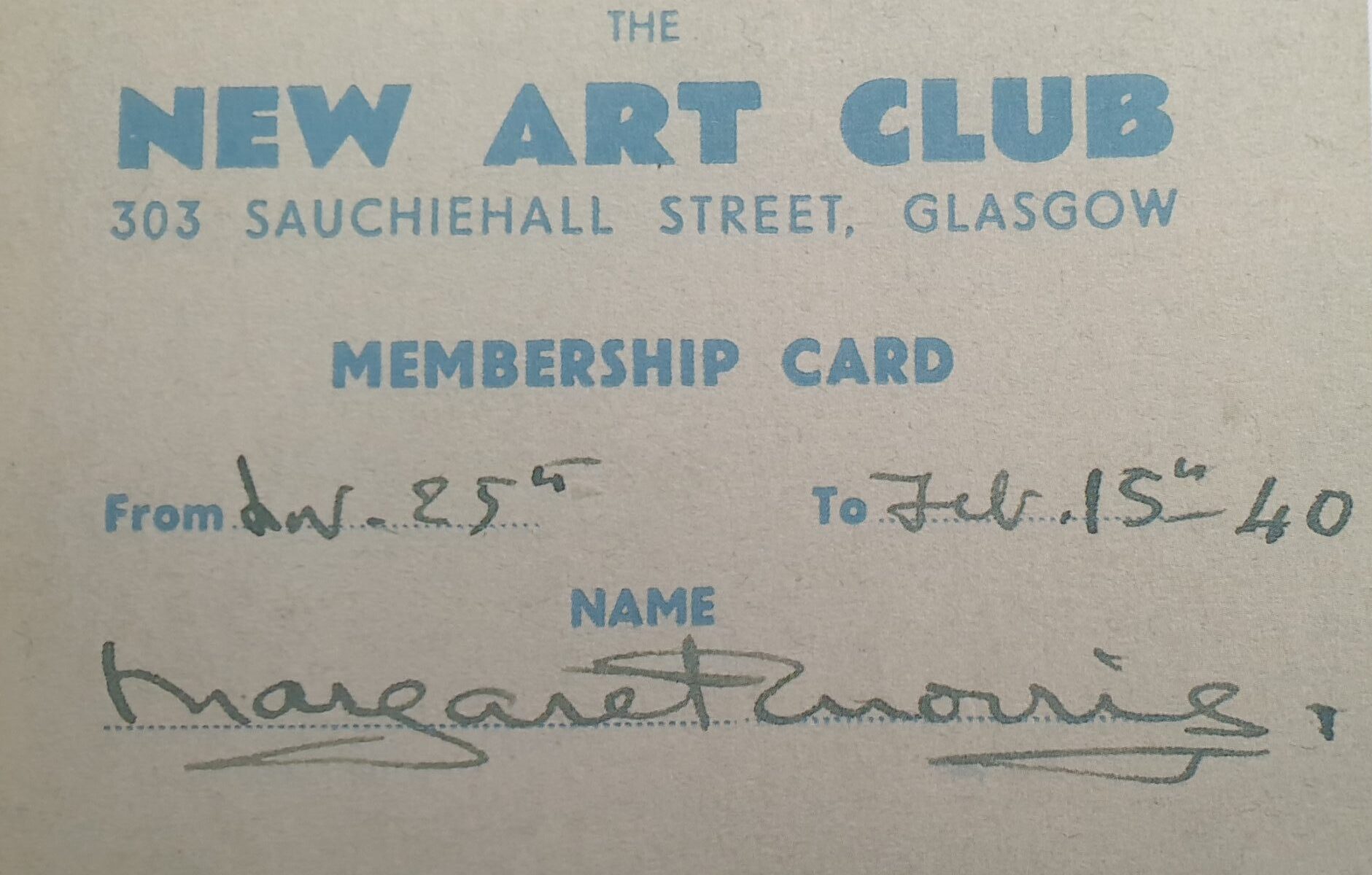
In 1940, Jean’s tea rooms, in 303 Sauchiehall Street, played host to the inguinal meeting of the New Art Club
Louise Annand’s painting in 1944 reflects the vibrancy of New Art Club and in her book on JD Fergusson in Glasgow 1939 to 1961 there is a key to unlock the picture.

The initiative for the organisation, was a borrowed idea by JD Fergusson from the French Salon des Independants. Under his watchful eye, as the elder of group, a strong believer in independent art and freedom of expression. He founded a society which although historically short lived has had a lingering influence, the club held bi-weekly meetings, it was in todays terms ‘a creative sandbox’,
For a modest fee, it provide an enlighten environment to view and discuss each other’s work. Artists were able to exhibit work in monthly exhibitions on no jury system paying a modest hanging fee.
For the young or non-established artists in this period there was no regular gallery spaces where they could show their work except at the annual exhibitions of the Royal Glasgow Institute of Fine Arts.
The art scene of this period was difficult for an independent new artist to break through as it was dominated by academic art and galleries with a refined and somewhat prescribed taste.
The Glasgow Art Club was a conservative environment with a membership gender bar and the subscription was out of the reach of most independent and struggling artists.
Members of Fergusson’s group formed the New Art Club in opposition to the established Glasgow Art Club and attracted the interest of both trained and untrained artists of all ages and sexs.
JD Fergusson, a champion of the ‘independent’ artists, said that the idea of a new art club came from a meeting held at Glasgow School of Art – ‘very appropriate’ as he said, ‘since the architect of the School, Charles Rennie Mackintosh, was one of the most independent artists Scotland has produced.
The New Art Club twice weekly meetings went on for several years and consisted of more than just art, but also discussion groups, poetry, and music.
The monthly artist-members exhibitions with its no selection committee allowed qualified and self-taught artists, young and old to hang side by side with members freely discussed each other’s work.
Fergusson and Margaret Morris, being older than the other members, tended to show their earlier works for fairer comparison. After a time the club found a more permanent space at the already established Margaret Morris Movement premises at 299 West George Street and the exhibitions continued there.
One such younger member, artist Millie Frood, in her picture ‘coffee morning’ reflects one of these exhibitions with two gentlemen in debate. Whilst the artist delivery is exciting, it is its content that is extraordinary. It is a portrait of the group’s two key early members Josef Herman and Jankel Adler.

In November 1942 the New Art Club held their first meeting of their own exhibiting society, the ‘New Scottish Group’, (NSG) with Fergusson as its first president.
With in months a number of the most active members decided to hold their first public exhibition. It took place in Apiil 1943 at McClure’s Gallery, Wellington Street and became the first exhibition of the New Scottish Group opened by James Bridie and with a catalogue forward by Naomi Mitchison
The artists included Andrew Taylor Elder, Marie de Banzie, Donald Bain, Louise Annand, Millie Frood, Isabel Babianska, Anne Cornock Taylor, John Morrison, Betty Simpson, Sheila McArthur, Leslie Nurse, George Hannah, sculptors Helen Biggar, George B Innes, TS Halliday and of course works by Fergusson and Morris.
In May 1944, the NSG opened its second group exhibition at the McClure gallery. Opened by T.J. Honeyman and a catalogue forward by Alan M. Based.
The following May in 1945 the NSG held its third exhibition at McClure’s Gallery opened by Hugh MacDiarmid with catalogue forward by Maurice Lindsay. Running concurrently with the third Glasgow NSG exhibition was a smaller NSG Dundee exhibition at the Art Society Rooms
The end of the second world war and with the freedom of movement saw core members of the Group leave Glasgow, the first being Isabel Babianska.
1946 saw the forth and last NSG Group exhibition at the McClure gallery opened by Joseph MacLeod with catalogue forward by William Montgomerie. In October to November of the same year the Group exhibited at Carlisle Art Galleries which was opened by Margaret Morris.
The Society of Independent Scottish Artist’s in 1947 held as part of the first Edinburgh Festival a exhibition of modern Scottish painting with several of NSG artists contributing works as well as Robert Colquhoun and MacBryde both heavily influenced by Jankel Adler.
The New Scottish Group, created a publication with a moving forward by JD Fergusson printed by a friend of the Group, art publisher William McLellan. It is important as it acts as a repository of the forwards from the NSG’s previous exhibitions as well as nine colour and seventeen monochrome reproductions of the key members work.
One of the Group’s key achievements was the great encouragement it gave to serious artists of varied backgrounds, providing them with a reason to paint and an opportunity for free exchange of opinions on art. For the public it provided a introduction to the art of the upcoming generation.
Fergusson wrote ‘The most useful things the New Art Club has done is to have proved that independent Art can exist in Glasgow…What was wrong with Glasgow was not that there was academic Art but that in Glasgow there was only academic art.’
By 1951 the Group held its first retrospective New Scottish Group exhibition, opened by Earl of Selkirk at the McLellan Gallery with catalogue forward by William Power.

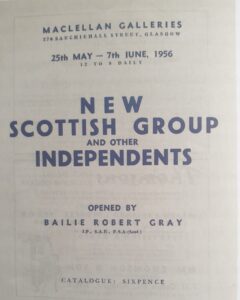
In 1956 a combined exhibitions of the New Scottish Group and Independents took place and included many up and coming new contemporary artists with a festival exhibition of NSG works in May to June at the Wisham Community Centre, Lanark and seven other centres.

While there was another exhibition in 1956, it was not until 1968 that the last public exhibition of their work was held by the Scottish Arts Council, New Paintings in Glasgow 1940 to 1946. It was another 20 years before there was another opportunity to see the Group’s work at Cyril Gerber gallery who in 1988 on the death of Millie Frood undertook a retrospective of the her work and associated artists from NSG.
Since then it seems that the group and many of is main supporters have been forgotten or fallen out of current taste. As a group in its life it was unfairly described as important as a movement with no one artists of merit. This under estimated the talent and innovation within the Group’s members.
The group had no single style, but shared left-wing or nationalistic tendencies and included artists influenced by contemporary continental trends, as a whole this was the movement that pushed Scottish art towards a celitic expressionism.
It was shunned by the academics and press at the time but the movement was important not only in allowing independent artists to show but in allowing artist to freely experiment with expressionism, colour and movement.
They led the way for the post second world war artists in Scotland changing the palate to that known today as equestially Scottish.
Now the movement and many of the artists are sadly not recognised. The NSG created the environment for an artistic revolution to occur and whilst its existence was but brief its influence lives on
This movement deserves to held with equal regard as the Glasgow Boys and Girls, the Colourist and the New Glasgow Boys and needs to find its own place in the Scottish idiom.